Wednesday, April 16, 2014

Spinning Affairs

I've been whipping yarns off the wheel! I sneak into my corner when I can and work a little more.
In the midst of the lavender batts spinning I snuck in some different fibre. 
This was pin-drafted rambouillet-targhee cross. It was certainly a very different fibre and prep from what I am used to.


It spun into an incredibly lofty yarn with a supported long draw. It took a while to figure out how best to spin it and draft it.  In the end I have 3 skeins totalling just under 300m of thick and thin averaging a DK/light worsted weight.  I'm thinking of doubling it up for a bulky cowl.

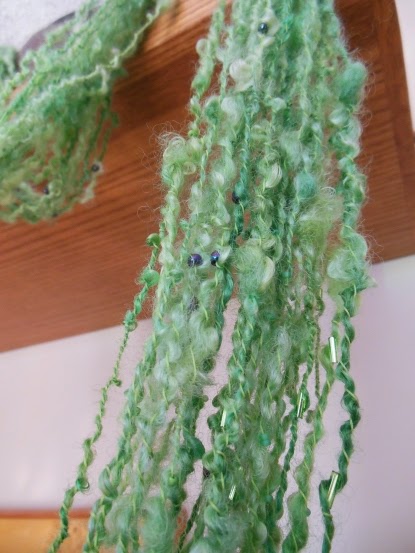
Then I moved on to my first beaded art yarn.
Oh boy, I did not love the beading part.  Spinning the BFL locks was a lot of fun and I look forward to finishing the bag of locks - but I won't be beading that yarn.
I now have 67m of beaded yarn to play with.


It took a while to finish plying this yarn because I ran out of beads, decided to measure out how much more beaded thread I  needed, then add more beads to the thread, then untangle the thread... but it's done now.

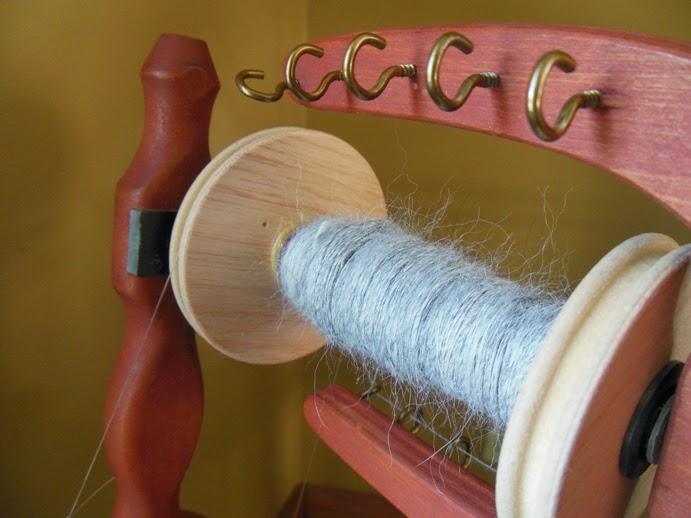
It wasn't long before more fibre found its way onto a bobbin. I was looking to make a particular yarn for a Starry project. I thought it was time to spin my 8oz of silver alpaca-silk.

But the alpaca-silk insisted on being spun much finer than I need for this project. This will be glorious lace yarn. When the single broke I took the opportunity to switch projects on the wheel and transferred the fine singles to a chopstick for later.


NOW I have this amazing BFL from Waterloo Wools on the wheel.  It's the closest colourway I had in my stash for the intended project. I'll simply amend my project to be stars over the ocean!
The colourway is Rocky Shores. I almost spun the first half of the 4oz braid in less than 24h. Yep, I'll be knitting in no time!

UPDATE:
Less than 3 days after starting I have about 280m of fingering weight yarn (in 2 skeins)

2 bobbins of singles

First bobbin of plied yarn

Skein 1 drying indoors

Skein 2 drying outside in the wind

Skein 2
Checking colours together before washing.


Wednesday, April 9, 2014

batty

When I ordered my new spindles, I threw in a batt order - you know, to cushion the tools better. It was described as "lavender batts" - not much to go on, but pretty enough to make me want it. The original etsy listing had a bit more detail concerning fibre contents, but when the seller kindly combined the order into a custom package and added the batts, that information was not included. I didn't notice/care until I opened the batts and discovered how different the fibres are. I am approaching it as a lovely mystery.


After consulting with some fellow spinners on Ravelry, I decided to start spinning this from pseudo-rolags.  My 5yo (now 6yo) helped roll the first batt's rolags, but they didn't spin up as smoothly as I hoped. I used the technique of gripping the fibre between two sticks to roll it (as described in the Spin Off article I'd read on the technique), but I think I made them too tight. And too fat.


Went back to Ravelry forums to see what others have said about making good p-rolags and realized the tight/fat problem.  For the second batt I've rolled them with less fibre, by hand, for an airier p-rolag.  This batt seemed to have more of the dark fibre so I made sure to spread it out. Sections of my first yarn are just dark fibres and I want it blended better - without carding/blending. Those dark sections will be balanced later with plying - or so I trust. 

These p-rolags drafted easier than the first batch, but there are still large sections of dark fibre because the dark and the light do not draft together well being such divergent lengths and texture.

It seems the first batt was significantly more than the second. Especially considering I tended to have thicker spun sections in the first.
 It's probably just as well the second batt wasn't as big. I don't think I was going to fit much more on the bobbin.  As it was, I was having a difficult time finding the right balance of take-up as the bobbin filled.

As I was dragging (carrying) a couple of dining room chairs into my tea/office/spinning room I decided I really need a niddy-noddy.  Taking a spindle full of yarn over to chairs is much easier than taking chairs to the wheel.  Finished yarn is about 137m of DKish 2-ply yarn (as I suspected the weight would be).

Skeining
More yarn - the second bobbin of 2ply.


I was initially intending a 3-ply yarn with the 3 batts, but I'm not sure 3ply would add any significant benefits to the final yarn, for my purposes, and I could get more yardage from a 2ply. So, that's what I did.


In total, 267m of BFL-merino yarn.

I'm trying out a new design with it, but I'm thinking I don't have enough and will have to rethink its usage.
What I do know is that it's lovely to knit with.

Tuesday, April 8, 2014

Spinner's control card

I couldn't be bothered to purchase a spinner's control card. Mostly I refuse to pay Canada Post's exorbitant shipping rates if I don't have to. So I made my own. I'd still like to laminate it (I actually printed four on a sheet) and I know there are self-laminating kits at the dollar store. For now the vellum paper will have to do alone. Or maybe I'll "laminate" it in some clear shipping tape.

Perhaps you are wondering how I know what thickness to make the lines.
Here's what I did.
I opened Word.
I drew a series of lines with different point values starting with .5pt, 1pt, 1.5pt, and so forth up to 10pt. I don't think I'll be spinning thicker than that and if I am it will be a funky art yarn and I won't be checking a control card.
Next I measured several of the line thicknesses.  Turns out 10pt is 1/8". At least that's how I measured it. That would mean a 10pt line is 8WPI and a 1pt line is 80WPI. By my measurements.
However, I've just been informed by a techie that 72pts is 1" - thus 1pt would be 72WPI and I need to recalculate. Well, my measurements are pretty close at that range and it's all rather subjective when you're comparing your spinning with a control card anyhow. Heck, WPI is really subjective! I did some rounding/approximating for some of the odd numbers.

I found that the most useful pt widths were:
1pt (80WPI - I'm sticking with my measurements for now)
2pt (40WPI)
2.5pt (32WPI)
3pt (28WPI)
3.5pt (24WPI)
4pt (20WPI)
4.5pt (18WPI)
5pt (16WPI)
6pt (14WPI)
7pt (12 WPI)
8pt (10WPI
9pt (9WPI)
10pt (8WPI)

Now to put it to good use.

Wednesday, March 12, 2014

Putting handknits to good use

Snowperson 1 is modelling a crochet pigtail hat (sans pigtails) and crochet mittens with a double-garter knit scarf. Snowperson 2 is modelling an oversized adult pixie hat (and commercial scarf/mittens).  Snowperson 3 is modelling a crochet witch hat in child size (brim up, point fallen) and knit mittens (with fleece scarf).
Child was too warm to continue wearing winter gear. That's one warm afternoon's work.

Saturday, March 1, 2014

Spring Please

What to do with those first couple skeins of wheel-spun white alpaca and spindle-spun, wheel-plied merino? Neither yarn was my best work as I was trying out new tools using the fibre samples that came with my new spindles. I don't even know how many grams of fibre I started with.
Decided to do the same with this fibre as I had done with the last mystery spinning - make a pi hat to use up the yarn and finish with a stretchy hat band in a commercial yarn.

 Started with an i-cord and then used pi shaping from there. As the circle increased I did my doubling earlier than called for because I didn't want to have to stretch the fabric too much. Plus, that alpaca wasn't stretching as well as I'd like. KFB inc's at the start made the fabric quite tight I noticed. Switched to twisted YOs later and did a partial increase with the buds because I didn't want to double again.

 Late night photo shoot silliness in the bathroom.


 Trying to be serious. lol.

 Serious didn't last long. It was boring.

It was fun to spin and knit, but large slouchy hats don't suit me - even though I wish they did. I also don't think I pull off apple/lime green.  It reminds me of Spring (project link)- that ever elusive season.


Lucy thought it was spiffy on the bowl blocking. Claire could probably wear this hat - if she wasn't a year old.  For now it sits by the wheel as a "sample" of my first wheel spun/plied yarns.

Thursday, February 27, 2014

explorations

I continue to explore my spinning tools...
The green apple (my name for the colour) merino did not love being spun on my support spindle (or, I didn't love it), but I did work on it for a while before plying on a Turkish. Finished 'turtle' is above.  The merino did love being spun on my new top whorl though.
I couldn't resist plying the top-whorl spun on my new wheel. Just because I could. It was fun.

My real explorations, however, were with 3 delicious red batts.
The first batt was spun and plied on my old familiar Turkish spindles.  All were spun woolen-ish from the fold of chunks I tore off the batt.
You've seen the pics before.

Finished Turkish hank. Rakestraw pre-plying. Topwhorl in progress.
Next I moved on to spinning on a Rakstraw spinner, but I was not liking that and discovered there is a small knick in the notch that was catching my fibre. I plied my wee bit of yarn and moved on to my homemade top whorl. Wow, was that a fast spin.


As I was working on the top whorl project I also started on my support spindle project with the third batt.
Both were plied on my larger top-whorl spindle.  I tried plying on the support spindle but what I should have done was make a plying ball first rather than try to control two bobbins of singles.

In the end I have 3 gorgeous and subtly different hanks plus 2 mini hanks.  From L-R are the Turkish-spun (87.8 m), Top-Whorl spun (117.5 m), and Support-spun (106 m) hanks.  Along the bottom are the Rakestraw mini hank and the leftover-singles hank.  Yardage also differed rather significantly. I am assuming each batt was an ounce (I had 3 batts in a 3oz bag) but I don't have a good scale to weigh them.  I will try to weigh the skeins before knitting.

I discovered I can do roughly the same yarns with each of my spindle tools. Turkish is probably my slowest tool. Top whorl I can make spin the fastest (of these 3). Support spindle allows me to spin while nursing as I can place it on the floor/bed in front of me, so that makes it easier for me to spin. This particular support spindle isn't as fast as my lighter Tibetan style, but I didn't want super-fine singles. I still got quite fine singles.
I think the Turkish is the most consistent. Perhaps because it's the most familiar to me but also because the slower spin allows me to better control my drafting.  I deliberately allowed myself to spin on each tool as felt most natural rather than try to make the exact same yarn.
If only I had one more batt to compare my wheel spinning - although it's too soon to expect a good consistent yarn for proper comparison.

My next challenge will be these batts on my wheel.  I am going to take advantage of my inconsistent wheel spinning for a thick-thin yarn.  I've never tried to spin a batt that wasn't thoroughly blended and with such divergent fibres.


Tuesday, February 25, 2014

south-bound shawls

I don't do hot and humid well (as tempting as it may be during the multiple recent cold snaps; -40C with the windchill). You won't find me vacationing in the Caribbean, or South America, or Mexico. However, three shawls I knit have traveled there.  Most recently I knit a bridal shawl for my sister's BFF for her destination wedding in the Dominican Republic.  This is a beaded Flutter of the Wings design by Lily Go knit with Cirrus lace yarn custom dyed by Cloud 9 Fiberworks here in Winnipeg.  The bride's ring is blue sapphire, so that is the colour we matched.  Her bridesmaid/complimentary colour is coral - which is very difficult to match.  Sis and I imagined she'll get more use from a blue shawl.  I'm looking forward to wedding photos (of the bride, the shawl, and my delightfully pregnant sister in her bridesmaid gown).

Quick photos before I packaged it up.

showing the beading details, which are throughout the shawl and much easier to see in person. iridescent white beads.

a terrible picture, but I needed something for size reference
Before this, I knit a shawl for my friend to wear at a wedding in Mexico. She had tried making it herself, but as the event drew closer (about a month away) she knew she'd never finish it. She had the  tip started, but since our gauge differed wildly, I restarted.  The merino silk lace yarn, by Zen Garden, was a pleasure to knit. (The pattern, while beautiful in the end, was very poorly written and charted.)


Shortly after the Mexico-bound shawl and just before I moved away from Ontario, I knit this commissioned Bella Botanica shawl for a friend to gift to a family member in Brazil. It has beads replacing the nupps because that's what my friend wanted (ooh, I'm overdue for some nupp knitting. I love nupps.)  The yarn is lovely lace Classic Elite silky alpaca.


On bitterly cold days, while I'm wrapped in heavier, warm shawls, I like to think of my airy "children" vacationing or living somewhere warm and sunny.  As spring (eventually/inevitably - right?) shows itself I'll be happy to start shifting over to my lighter shawls.  Truth is, even light weight shawls can provide wonderful warmth as they trap the air.  Warm in winter, breath well in summer - what's not to love about lace shawls all year?